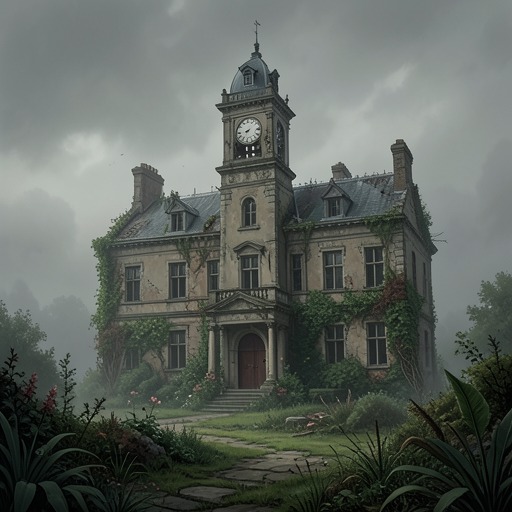
Lady Rose Bluff-Gore
The Darling Buds of MayLady Rose Bluff-Gore enters the narrative through a chance encounter with Pop at a champagne gathering, but quickly becomes more than the owner of an old mansion: she is its dissatisfied inhabitant, already wishing to pull it down, and a potential negotiating partner for the demolition Pop has proposed. Her brief exchange with him makes the threatened house a point where private frustration, financial strain, and Pop’s opportunism meet.
Identity and Introduction
Lady Rose is introduced as a tallish woman wearing a small grey tweed hat with a peacock feather. She approaches Pop gently, drawing him away by the elbow, and addresses him while eating cheese toast and drinking champagne. Her ivory teeth are described as remarkably long and large, an unusually vivid physical detail in an otherwise economical introduction. She recognizes him as Mr Larkin and asks whether he remembers her, establishing that they have met before, though the available scene does not explain the earlier occasion.
The meeting takes place amid the social bustle of the gathering, with Pop occupied in keeping drinks topped up. Lady Rose’s measured approach contrasts with his informal manner: she raises the matter of his proposal about the house, while he answers bluntly that it is time the place was pulled down. The conversation immediately establishes a practical connection between them, but the narrative also reveals that the suggestion touches a wish she has held independently of Pop.
The Mansion and Her Private Wish
Lady Rose has been thinking about Pop’s proposal throughout the afternoon. She has long wanted to demolish the house herself, so his suggestion does not impose an alien plan; it gives voice to a desire she already possesses. When Pop asks who wants such old places, her private response is essentially agreement. The mansion, to her, is not simply an imposing residence to be preserved, but a burden whose removal might make a different kind of life possible.
Her thoughts connect the house to its surrounding outbuildings and to the family’s economic condition. She would like to pull down not only the mansion but also the miles of greenhouses, unused stables, and draughty barns. She imagines that the sale or removal of these properties might leave some money in the bank, instead of forcing the household to live on overdrafts. Her desire is therefore presented as both personal and material: clearing away the estate might mean an end to upkeep and debt, and a chance at comfort she feels has been missing.
The possibility of her daughter Rosemary returning is part of that imagined future. Lady Rose wonders whether the demolition and resulting financial change might bring Rosemary back. The narrative does not establish that the daughter will return, or that demolition would secure her return; it presents this as one of the hopes Lady Rose attaches to a substantial change in the family’s circumstances. The old house thus carries more than architectural weight for her: its future is bound up with a possible family reunion and a more comfortable home life.
Negotiation with Pop
Lady Rose does not leave the conversation at the level of shared opinion. She asks Pop what he thinks the house is worth, inviting him to assess the property and put a value on the proposal. Pop says he can take a look the next day and let her know. For him, the offer immediately becomes a practical calculation: he anticipates estimating the value of bricks, tiles, doors, flooring, and hardcore, then contacting Freddy Fox to arrange a deal. His interest is in the usable material and the prospect of a quick transaction.
The exchange therefore joins two distinct motives without making them identical. Lady Rose sees demolition as a way out of the burdensome estate and imagines that it could improve her family’s finances; Pop sees a large supply of recoverable building material and a commercial opportunity. The house is at once her unwanted inheritance of upkeep and his prospective stockpile. The narrative makes their interests compatible enough to begin a negotiation, while showing that each approaches the same building from a different side.
Lady Rose then tests whether the arrangement might involve more than a simple valuation. She suggests that she and Pop could come to “some little arrangement,” a deliberately indirect proposal that he initially says he does not understand. He soon catches her meaning, and his internal response is that women are clever; he privately gives her the nickname “Lady Five Per Cent.” The label shows Pop translating her tactful overture into the language of a business commission, though the passage does not specify any agreed percentage or record a completed deal.
Characterization and Narrative Significance
Lady Rose is characterized through the distance between her composed public manner and the force of her private dissatisfaction. She smiles over champagne and cheese toast, yet has spent the afternoon considering a radical solution to the estate’s problems. Her wish to pull down the mansion is not presented as a sudden reaction to Pop: she has wanted this for a long time. His proposal matters because it offers a practical route toward a change she had already desired.
Her hopes remain conditional rather than fulfilled. She can imagine money in the bank, greater comfort, and Rosemary’s return, but these are possibilities in her thoughts, not outcomes confirmed by the episode. Likewise, she opens negotiations with Pop, but the scene ends without an agreed price or completed demolition. This gap between imagined relief and unsettled business keeps her future open while giving the mansion a sharply double meaning: to Pop it is a cache of materials, and to Lady Rose it is an obstacle that might be cleared to make another life possible.
The encounter also places her within the narrative’s contrast between declining country estates and Pop’s energetic, opportunistic commerce. Lady Rose’s household is associated with unused buildings and overdrafts; Pop responds by seeing saleable bricks, doors, and flooring. Neither perspective cancels the other. Her dissatisfaction supplies the human reason the transaction might proceed, while Pop’s practical eye supplies a means of acting on it. In that brief convergence, Lady Rose becomes the person whose private wish could turn the mansion’s decline into an actual business arrangement.